
Wamkelekile, Welkom
‘The Fifth Step’ exposes the tension between masculinity, addiction and the cost of truth
15 September 2026 | Story Nomfundo Xolo. Photos Lerato Maduna. Read time 8 min.
At the Baxter Theatre Centre this September, a dark comedy about addiction, masculinity and the cost of honesty puts two University of Cape Town (UCT)-trained actors in close quarters with a story South Africa has been avoiding.
Led by award-winning director Charmaine Weir-Smith, David Ireland’s acclaimed two-hander comes to The Baxter, where two men confront what recovery demands when honesty becomes unavoidable.
The territory The Fifth Step enters is one South Africans may recognise: a culture in which alcohol is woven into celebration, family gatherings, after-work socialising and weekends around the braai, while choosing not to drink can itself invite suspicion. In that context, alcohol is not only a private habit – it shapes how people interact, how men show confidence, how conflict is handled and how long someone can avoid admitting that drinking has begun to damage their relationships and sense of self.
Albert Pretorius is direct about where South Africa stands. “I personally believe South Africa has a drinking problem. If we celebrate, there’s alcohol; if we socialise, there’s alcohol. If you look at all the crime stats, most of them have some form of substance linked to it.”
His co-star Lyle October points to the familiar question directed at someone who chooses not to drink: Why aren’t you drinking? “You’re judged. But I find it interesting how it’s gotten to that point where, if you don’t drink, you are weird.”
The relationship at the centre
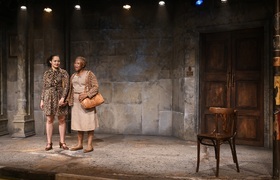
Currently running until 26 September, Pretorius and October star in an 85-minute production set around Alcoholics Anonymous (AA) and the work of recovery. Pretorius plays James, an experienced AA member, while October plays Luka, a volatile newcomer whom James agrees to sponsor. As Luka prepares to complete the programme’s fifth step, alcohol is the reason they are in the room, but also the pressure beneath every conversation. It has shaped how Luka behaves, how James understands responsibility, and what both men are willing to reveal about shame, masculinity, faith and accountability.
It is an unusual relationship to place at the centre of a play. “It’s not lovers; it’s not family; it’s not friends,” Pretorius said. “But it’s an incredibly intimate relationship because you tell your sponsor everything. It really forces you to be honest with yourself and each other for your recovery.”


As Luka moves towards his confession, the line between sponsor and sponsee begins to shift. James is forced to confront his own history and assumptions, while Luka’s volatility gives way to a more complicated picture of what a person can carry beneath the surface.
Both actors trained at UCT and first shared a stage two years ago on Othello. For October, that collaboration marked the beginning of a working relationship that has continued to deepen. “You never know what someone’s going through. It could be the most normal person, but underneath, everyone’s fighting their own battles. What they’re going through is honestly going to be more than what you see on the surface.”
Despite the weight of its subject matter, The Fifth Step is a dark comedy. Its humour comes from the messiness of life itself: people joke in difficult moments, deflect when conversations become uncomfortable and sometimes find something absurd in what is otherwise painful. “Life is serious, but mostly it’s also really funny,” Pretorius said. “There are some really clever moments in the script.” The result is a play about recovery that is equally interested in the relationships people build while trying to change.
What men are taught not to say
The production also opens a wider conversation about how men are taught to handle vulnerability. Pretorius described the expectation of the “stiff upper lip” as something that extends well beyond South Africa, while the theatre rehearsal room demands almost the opposite: weeks of examining emotions, relationships and behaviour closely enough to find what sits beneath a line or gesture. That openness, he argued, needs to exist outside the theatre too. “We need to talk more and be more honest and more accountable. You don’t have to always talk only when your life is in crisis.” For him, it can be as ordinary as having friends with whom he can speak honestly about insecurity, uncertainty or simply a difficult day. “You don’t need to walk away feeling like, ‘My friend, we solved the problem.’ Just saying it out loud really helps.”
October agreed. “We have all these structures and all these rules and all these perceptions about things, but at the end of the day, humans are messy and our lives are messy. Everyone makes mistakes. Everyone can try to be better.”
What addiction actually looks like
The play does not present addiction as a simple matter of individual weakness. Watching it, you can see how alcohol dependency can be inherited through family patterns, shaped by trauma or learned by watching a parent use drinking to cope with pain. For Luka, the presence of an older man who can offer guidance matters, but The Fifth Step does not turn James into an uncomplicated figure of wisdom. He is older, more experienced in recovery, and still flawed, vulnerable – and still confronting his own weaknesses.
Pretorius does not expect audiences to leave transformed, nor does he see the production as a sermon. What he hopes for is smaller and, perhaps, more meaningful. “If it gives people a little bit of hope, if it makes one person go, ‘I need to talk about something with someone’, if it makes someone laugh, if it touches someone in any way, it’s a win for me. I’m not here to tell you how to live your life.” He described the actors as a mirror for a particular part of society: allowing audiences to recognise something in the characters, themselves, or someone they know. “It might be to realise you have to have an outlet because you’ve been dealing with something, or if it’s just phoning your dad and saying, ‘Listen, man, I miss you.’"
For October, the play also offers audiences a glimpse into the support structures available through AA, and the idea that recovery does not have to be undertaken alone. “It will shed a light on that. It’s an actual thing. People can have a support system and these people can help you.”
Why theatre? Why now?
The actors make a case for experiencing it live, at a time when so much culture is consumed through screens and short-form video. “You need to go out to the theatre because it teaches you more about yourself than it teaches you about anything else,” Pretorius said. “You need to go out, be among people, watch flesh-and-blood human beings have a conversation.” Audiences bring their own interpretations, experiences and responses into the room. “You come and you take whatever you want, even if it’s nothing. That’s the experience of theatre.”
Perhaps that is where The Fifth Step finds its deepest connection to its subject. Its characters are dealing with sobriety, shame, faith and masculinity, but underneath those themes is a more fundamental question: What happens when you tell another person the truth and they choose to stay and listen?
 This work is licensed under a Creative Commons Attribution-NoDerivatives 4.0 International License.
Please view the republishing articles page for more information.