
Wamkelekile, Welkom
‘Rights do not self-execute’
09 September 2026 | Story Kamva Somdyala. Photos Lerato Maduna. Read time 8 min.
“Our Constitution emerged from one of the most deeply divided societies. It sought – through normative constitutional values – to establish not merely a different system of government, but a different kind of society.”
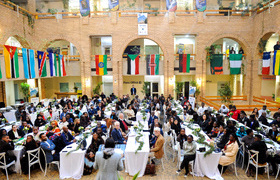
These were the words of retired Constitutional Court Justice Mbuyiseli Madlanga as he opened his address during the annual Rabinowitz Lecture held at the University of Cape Town’s (UCT) Faculty of Law on 4 September. His address was titled “30 Years of the Bill of Rights: The Constitutional Promise versus Lived Reality”. He used the platform to highlight issues relating to education, human dignity, housing and access to justice.
The society he referenced is “an egalitarian society that respects the reality that dignity inheres in every person – and for that reason, places at its core human dignity”.
“Also, key to the Constitution’s foundational aspirations were the establishment of a democratic, accountable, responsive and open society founded on the rule of law, while transforming the conditions in which people live,” he said.
“The constitutional promise was not simply that South Africa would become a constitutional democracy in which elections would be held, and institutions function according to law; it was that democracy would translate to the following: freedom – the tangible upliftment of the lives of those who, hitherto, suffered serious deprivation; hence the preamble’s promise to improve the quality of life of all citizens.”
“Inequality engenders in those who are treated unequally a sense of being lesser human beings.”
On education, he said that the system under apartheid was calculated to ensure that black students would not amount to much. “It was meant to entrench inequality and injustice. The constitutional guarantee to the right to education recognises education as a powerful instrument through which inequalities and injustices may be redressed, and the transformative aspirations of the Constitution, realised. This right serves as an affirmation to the idea that every child, regardless of race, background or circumstance, is equally deserving of an education that allows them to realise their full potential.
“Crucially, despite the fact that the right to education fits neatly within the category of socio-economic rights, the Constitution accords it a distinctive status. Unlike other socio-economic rights, this guarantee is not qualified by internal limitations, requiring progressive realisation within available resources; it is immediately realisable. Of course, for the enjoyment of this right to be meaningful, the introduction of quality education is necessary. The question then is: Do the everyday experiences of millions of children who enter our public schools each morning accord with this promise?”
He continued: “The guarantee of equality is not an end in itself. Inequality engenders in those who are treated unequally a sense of being lesser human beings. That in turn impinges on their self-worth. That concerns dignity. These two rights are intertwined. Since the advent of our constitutional democracy, courts have been integral in reinforcing the right to equality and dignity. Where necessary, they have invalidated laws found to be constitutionally wanting. On that front, an admirable body of jurisprudence has been crafted. Unfortunately, devastating realities persist mainly because redress towards making the promises of our Constitution a reality for all has not kept in step.”
Progressive constitutional framework
Madlanga added: “The recognition of everyone’s right to have access to adequate housing must therefore be understood as part of the Constitution’s broader transformative project, progressively to dismantle the consequences of the race-based spatial programme. What, in constitutional terms, does adequate housing mean? The jurisprudence of our courts provides some answers: according to the Constitutional Court, a home is not merely a physical space in which a person resides. The court situated the right within the broader constitutional value of human dignity; that is, a home is a place in which a person lives in dignity and with a measure of security. Living conditions that a bereft of dignity do not conduce to a meaningful, wholesome enjoyment of the right to access adequate housing.”


He prefaced access to justice with reference to women’s experiences in accessing said justice. “Their experiences are disheartening. The violation of women within the court system, where they should be afforded justice, happens with disturbing frequency. Unfortunately, this happens within a context where women are before courts to access justice after suffering ills which include physical and psychological torment at the hands of men. These violations leave raw, emotional and psychological wounds that may last a lifetime.
“How judicial officers handle and decide cases at the centre of which are such violations may mean the difference between contributing towards healing or opening these raw wounds even more. Judicial officers must ensure that even though not therapeutic, the court process does not aggravate. Courts undeniably play a crucial role in the transformation of South Africa.
“We adopted what remains widely recognised as the most progressive constitutional frameworks globally, anchored by a deeply transformative Bill of Rights. This foundational text was not intended to be a mere collection of abstract ideals. It promised a future explicitly defined by human dignity instead of institutionalised humiliation; democratic inclusion instead of political disfranchisement; freedom instead of state-sanctioned oppression; and substantive equality and social justice instead of inherited systemic privilege. Thirty years into democracy, the constitutional promise remains that – a promise.”
He concluded: “The lesson is not that the Bill of Rights has failed or that its promises were overly ambitious or unrealistic. Rather, the take-home is the sobering truth that rights do not self-execute.”
Among the attendees were retired Constitutional Court Justices Edwin Cameron and Albie Sachs.
 This work is licensed under a Creative Commons Attribution-NoDerivatives 4.0 International License.
Please view the republishing articles page for more information.