
Wamkelekile, Welkom
A republic built on allies
04 September 2026 | Story Stephen Langtry. Photos Lerato Maduna. Read time 5 min.
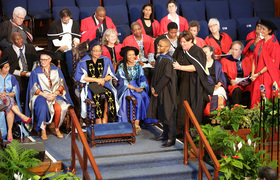
Professor Roman Roth from the University of Cape Town’s (UCT) School of Languages and Literatures delivered his inaugural lecture on 2 September.
Titled “Fighting for Mediterranean Empire: Rome and Her Italian Allies, 200–91 BCE”, the lecture reassessed how Rome built the first great Mediterranean empire in an often overlooked partnership with Italian states that supplied the bulk of its soldiers.
Rewriting the story of Rome’s conquests
Professor Roth began his argument by pointing out how lopsided the popular memory of Rome has become. “Most people with a non-specialist interest in history would at least recognise Caesar or Augustus or Nero by name,” he said, but “few members of the international public would readily recognise” the Roman commanders who, between Rome’s victory over Hannibal in 201 BCE and the outbreak of war with its Italian allies in 91 BCE, built what he called “the first truly Mediterranean empire”.
Quoting the historian Mary Beard who said, “Rome was an empire not because it had an emperor ... Rome had an emperor because it possessed an empire”, Roth argued that even this framing leaves out a crucial fact. The republic’s armies, he said, citing the ancient historian Polybius, “usually consisted of up to two-thirds of soldiers who were provided by Italian allies”.


For Roth, those allies were far more than conscripted auxiliaries. He challenged the “still dominant” strand of modern scholarship that treats them chiefly as coerced or exploited subjects of Rome. “This view of the allies as, at best, reluctant participants in Rome’s imperial conquest cannot be upheld,” he said, pointing to monumental building projects funded by war spoils, and to inscriptions showing allied states running sophisticated legal and political institutions of their own, independent of Rome.
His conclusion reframed the entire period. “Rome’s Italian allies may not have held the initiative in the republic’s imperial conquest,” he said, “yet their strong sense of being an integral and decisive part of an enterprise from which they greatly benefited creates an imperialist dynamic of its own.”
The extent of Rome’s dependence on allied “manpower, leadership, economic drive, and ... imperialist zeal”, he argued, “continues to be seriously underestimated”.
A crystal-clear narrative
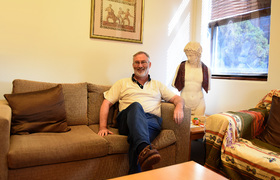
Roth’s lecture drew on decades of research into the Roman Republic and the material culture of ancient Italy. He is a fellow of the Alexander von Humboldt Foundation and of the Institute of Classical Studies at the University of London, and the author of Styling Romanisation. His forthcoming book, The First Roman Empire: Frontiers, Foundations and the Transformation of Italy, 450–91 BCE, formed the backbone of the lecture.
“He’s seen how the civic life of their communities was enriched by new facilities and by an inflow of wealth.”
Delivering the formal response, Professor David Wardle, King George V professor emeritus and senior research scholar in Classics at UCT, situated Roth’s work within the demands of ancient history as a discipline. “Imagine that you have been presented with a very large jigsaw puzzle comprising thousands of pieces,” he told the audience. “When you come to open the package, there’s no picture on the lid, only a brief title. After a great deal of work, you realise the enormity of the task, and the possibility that even if you can make out some of the key features of the puzzle, most of the detail is gone. As a historian of the Roman Republic, that’s what Professor Roth is faced with.”
Professor Wardle noted the breadth of expertise Roth brings to that task, praising the experience he brought to the discipline as a practising archaeologist and the philological skills he’s honed in classrooms and seminars. Roth’s account, he added, had done more than describe the allies’ contribution: “He’s shown how the elite of those allies benefited materially from their active participation. He’s seen how the civic life of their communities was enriched by new facilities and by an inflow of wealth.”
Wardle went further, suggesting the lecture unsettled a familiar label altogether. “Perhaps many of you came here this evening expecting a talk on the Roman Empire,” he said. "But Professor Roth has made us question whether that phrase is in fact one we should continue to use. In some sense, we should think of an Italian Empire.”
He noted that the occasion was a rare one: only the third inaugural lecture delivered in the Classics discipline at UCT in the past 40 years. He closed with a nod to the day’s symbolism: in the Roman calendar, 2 September marks the dies Actiacus, the anniversary of Augustus’s decisive victory at Actium in 31 BCE. It was, he told the audience, “a day celebrating a great Roman victory”, fitting for celebrating UCT’s own scholar of Rome.
 This work is licensed under a Creative Commons Attribution-NoDerivatives 4.0 International License.
Please view the republishing articles page for more information.